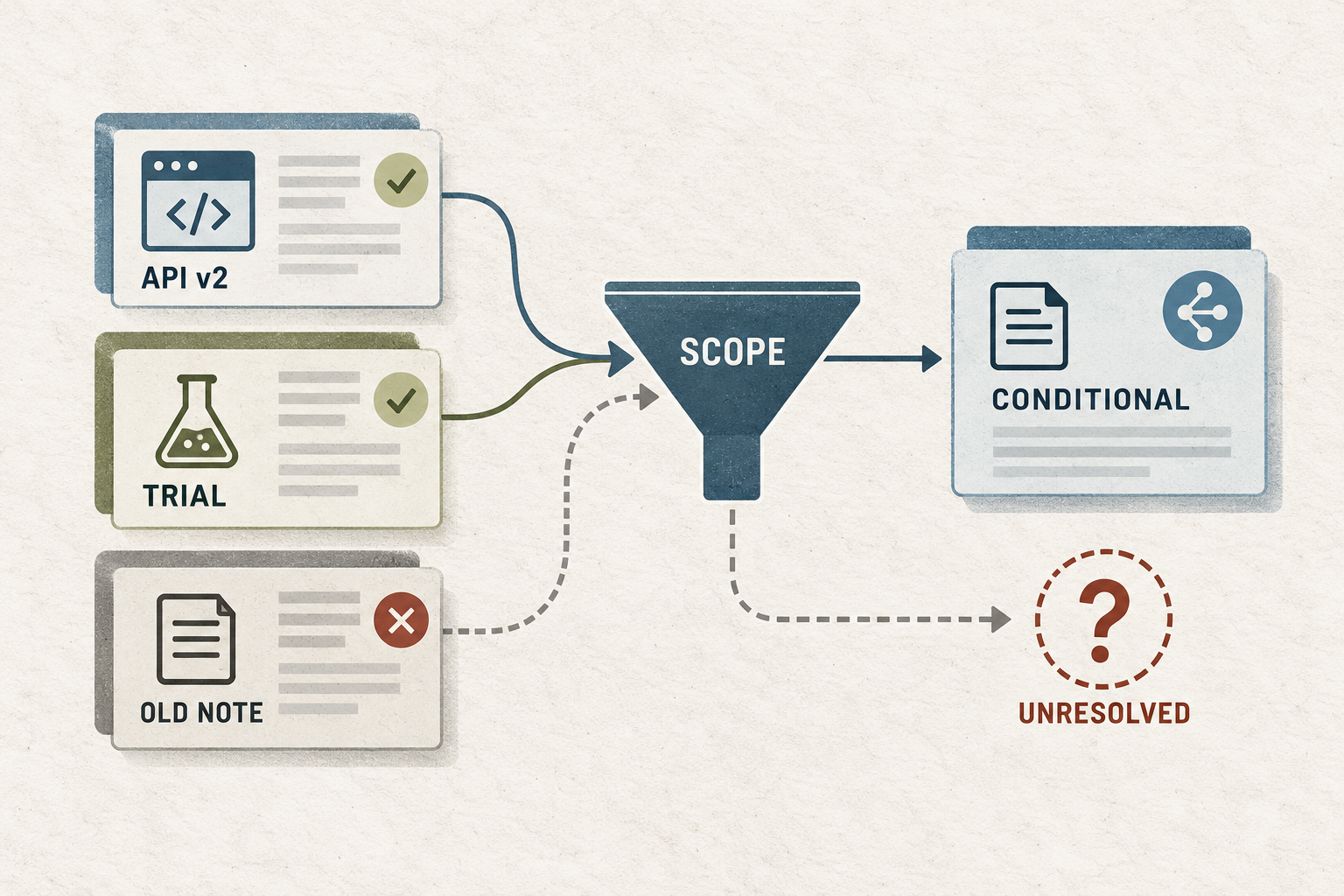
When sources disagree, an agent should establish whether they describe the same scope, version and decision before selecting one. Preserve the conflict and its provenance when the evidence does not resolve it. The first retrieved passage, the newest timestamp and the longest document are not universal authority rules.
There are also two distinct questions: which source supports a factual conclusion, and which instruction authorizes an action. A document can be relevant evidence without having authority to change the user's request or grant permissions.
Make the apparent conflict precise
Consider a fictional export service. Retrieval returns three statements:
| Source | Scope recorded with the statement |
|---|---|
| API v2 reference | Exports remain available for 30 days |
| Trial-account policy | Trial exports remain available for 7 days |
| Old internal note | All exports are retained for 14 days |
Those sentences alone are not enough to choose an answer. The trial rule may be an exception to the API reference rather than a contradiction. The internal note may describe an older release, a proposed change or a genuine unresolved inconsistency.
Record the source path or URL, revision, applicable product/account, owner or issuer when known, and exact supporting location. A retrieval timestamp says when the system fetched a document; it does not establish when the rule became effective.
The W3C PROV overview explains provenance in terms of entities, activities and the people or organizations involved in producing them. That is useful vocabulary for tracing evidence, not a built-in ranking of who is correct.
Separate scope differences from competing claims
For a trial user on API v2, first check whether the trial policy explicitly applies to that release and export type. If so, retaining the general rule and its exception can explain the outcome more accurately than discarding one source.
For a standard account, the trial rule may be irrelevant. For a later API release, neither old document may establish current behavior. Query expansion and metadata filtering should follow the question rather than treating every retrieved hit as equally eligible.
Our context, retrieval and memory guide explains why retrieving or remembering information does not make it authoritative. Here the additional task is to compare the conditions under which each statement applies.
Use a declared resolution policy
A project can define which document owns a particular contract and how amendments supersede it. Record that policy explicitly. “Prefer newer” is only useful when the sources are comparable and the newer one is an applicable, accepted replacement.
Likewise, implementation and specification serve different purposes. Code can demonstrate current behavior while an accepted contract describes required behavior. A discrepancy may be a defect to investigate; silently declaring the code authoritative can conceal the very regression the task asks the agent to fix.
The PROV data model includes relationships for derivation and revision. Such relationships can help retain an amendment chain. A revision relationship still does not prove that the replacement was approved for the decision at hand.
For the fictional export question, a small decision record might say:
Question: retention for trial accounts using API v2
Applicable rule: trial policy, revision T3, section 4
General rule: API v2 reference, retention section
Excluded note: revision N1 describes a superseded proposal
Unresolved issue: effective date of T3 must be confirmed
That is a proposed record, not a statement about a real product. If the effective date matters to the user's case, the unresolved field prevents a premature answer.
Preserve the conflict through handoff
A summary that says “retention is seven days” can lose the account type, version and uncertainty that made the answer conditional. Keep the qualifier and source location beside the conclusion.
Our handoff guide describes preserving decisions and unresolved questions. In a conflict case, include the competing source, the reason one was selected or excluded, and the check still required. Avoid copying the selected statement into durable memory as an unconditional fact.
For a future evaluation, give the agent the same three sources with several questions: trial versus standard account, v2 versus an unspecified release, and a date before the alleged amendment. Check the explanation and citations, including whether it abstains when required evidence is missing.
No model or provenance-system evaluation was performed here. The example demonstrates a decision procedure. A useful agent makes the source conflict inspectable and resolves only the part the evidence supports.