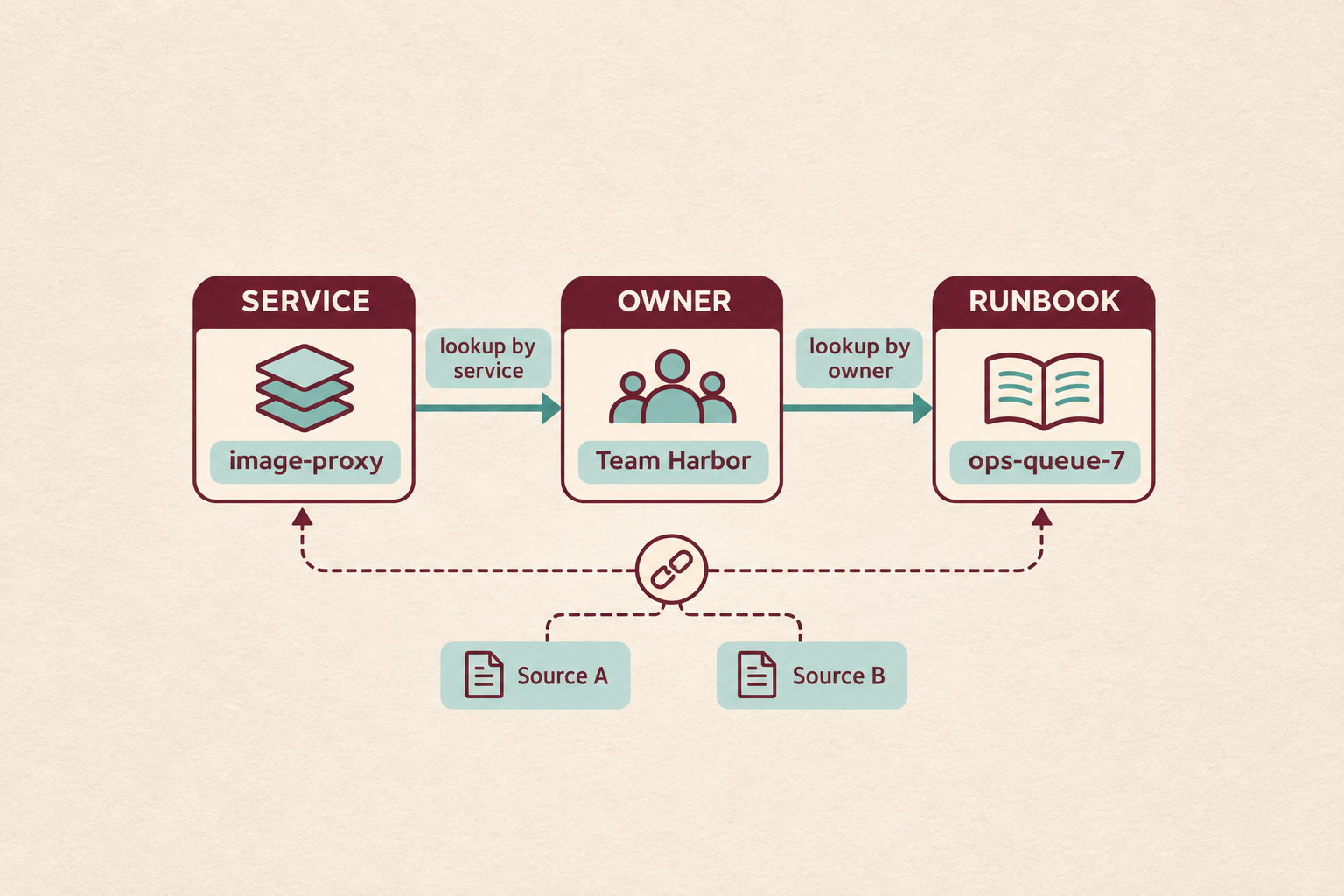
A RAG question needs multiple retrieval steps when an intermediate fact determines what to search for next. Preserve the evidence for each step, verify the relationship joining the documents, and refuse to complete the answer when a required link is missing or inapplicable. Retrieving more passages in one broad search is not necessarily the same operation.
For example, identifying the team responsible for a service may be necessary before finding that team's incident queue. The final answer depends on both documents and the relationship between them.
Make the dependency visible
Consider two invented records:
Service directory, revision 4:
image-proxy is owned by Team Harbor.

Team Harbor runbook, applicable to service revision 4:
Route incidents to ops-queue-7.
The question is: “Which queue handles incidents for the team that owns image-proxy?” A first lookup supplies Team Harbor; that value determines the second lookup. A reviewable answer keeps both source identities instead of citing only the runbook.
If the directory instead points to another team, the same runbook no longer supports the answer. A document can be relevant to the vocabulary of a question while joining to the wrong entity.
Choose another retrieval step for a reason
IRCoT studies interleaving retrieval with reasoning for multi-step questions. It is a useful mechanism reference, not evidence that adding a loop will improve every current RAG application. Its historical benchmarks and model configurations are not measurements of this proposed pipeline.
Use a second step when the first result supplies a needed entity, reference, version, or dependency. Do not repeatedly search merely because the system has not yet produced a confident-sounding answer.
A bounded plan can record the current question, the fact still missing, the eligible next query, and a stopping condition. That record can expose the evidence dependency without requiring a transcript of a model's private internal reasoning.
Verify the bridge, not just the endpoints
For the synthetic service example, inspect these conditions:
| Link | Acceptance question |
|---|---|
| Service to owner | Does the directory actually assign this service to this team? |
| Owner to runbook | Is the retrieved runbook for that team rather than a similarly named group? |
| Revision to applicability | Does the runbook apply to the service revision being answered about? |
| Runbook to queue | Does the cited passage identify the queue for this kind of incident? |
Keep exact identifiers where possible. Normalizing two display names into the same string can create a false join. A runbook for ordinary support requests may not support a statement about security escalation, even when both pages name the same team.
HotpotQA provides a research dataset with supporting facts for multi-hop question answering. The useful evaluation idea is to grade the evidence chain as well as the final answer; a correct queue name guessed without the supporting relationship should not rescue a missing-evidence case.
Apply permissions at every step
The first lookup does not authorize the second source. Carry the requesting identity and allowed evidence boundary through every retrieval, reranking, and citation path. A cross-reference into an inaccessible runbook is a missing eligible link, not permission to broaden the search credential.
Our access-aware retrieval guide follows that boundary through context assembly and reuse. A multi-step pipeline adds places where the same rule must continue to hold.
Also bound the number of steps, returned material, and repeated queries. Cycles such as “see the service directory” followed by “see the team directory” should terminate with a reported limitation rather than an unbounded search loop.
Test missing and incompatible evidence
A small local fixture used dictionary lookups to represent the two records. Three checks passed: a complete compatible pair returned the queue with both evidence IDs; a missing team record returned no answer; and a runbook marked for an incompatible service revision returned no answer.
Those are deterministic join checks on synthetic records. They did not run an embedding model, search engine, agent, or IRCoT implementation, and they establish no answer-accuracy improvement.
For a real evaluation, add ambiguous names, conflicting ownership, permission changes, outdated references, and questions needing only one retrieval. Inspect whether the extra step contributes required evidence rather than merely more text.
The useful result is a bounded chain of eligible passages supporting the answer's specific relationship. When that chain breaks, preserve the gap and explain what information is still needed.