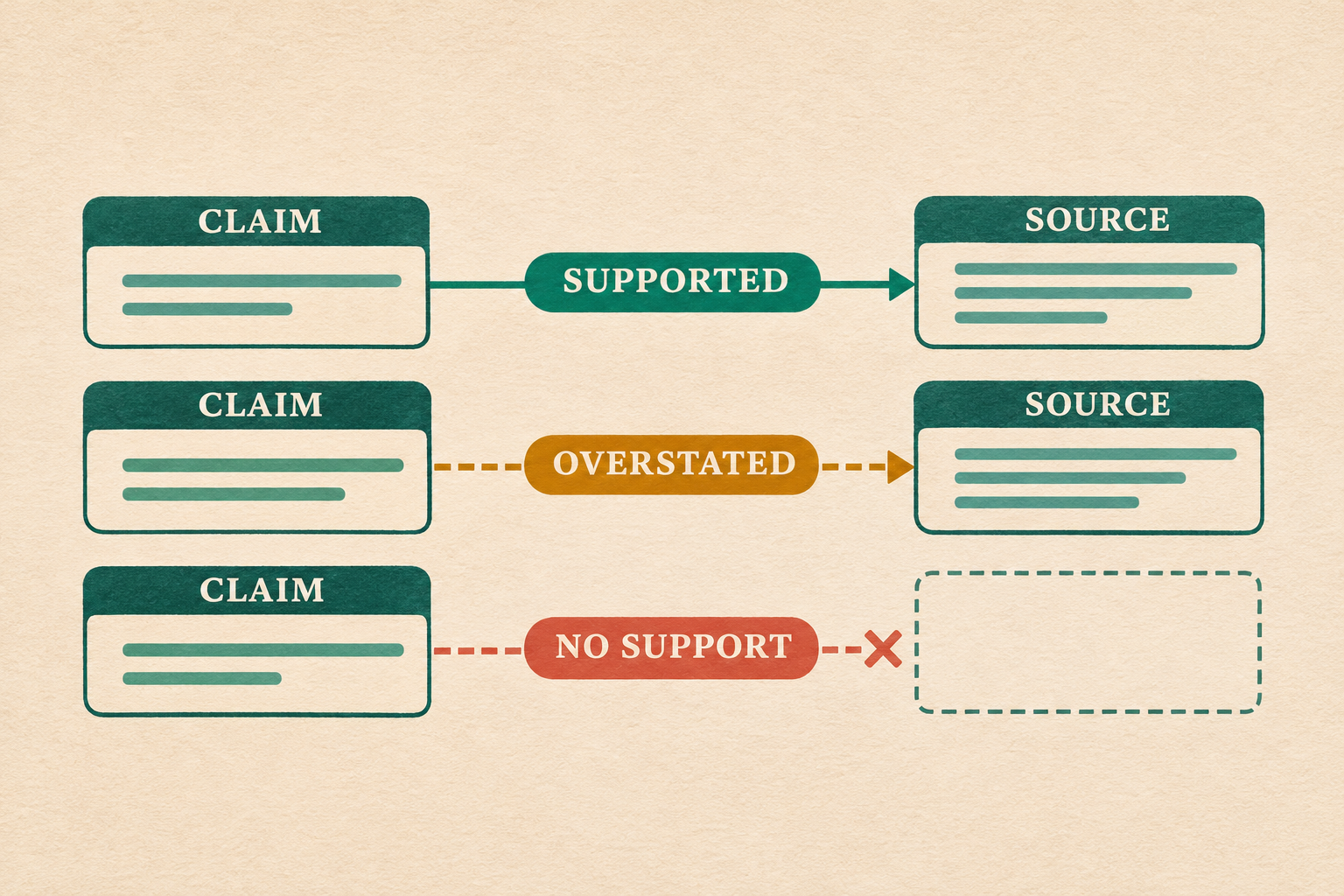
A RAG citation is useful when the referenced passage supports the specific claim beside it, within the right version and scope. A working link, a relevant document, or an exact quotation is insufficient if the answer broadens what the source says. Review both the correctness of each attribution and the important claims left without support.
Retrieval evaluation asks whether useful evidence reached the answering system. Citation evaluation asks what the answer did with that evidence. A pipeline can retrieve the right exception and still produce a confidently cited sentence that ignores it.
Split the answer into claims you can check
Start with the propositions a reader might act on. A sentence can contain several: a retention duration, an eligible account type, and an automatic-deletion promise. One citation at the end does not establish all three.
Use a deliberately invented policy excerpt:
Document: export-policy, revision 4, section 2
Completed exports on paid accounts are retained for seven days.
Trial-account exports expire after 24 hours.
This policy does not specify backup retention.
Now examine three possible answers:
| Answer claim | Assessment against this excerpt |
|---|---|
| Paid-account exports are retained for seven days | Supported within the stated scope |
| All exports are retained for seven days | Overstated: the trial exception contradicts it |
| Exports and backups are deleted after seven days | Unsupported extension to backups and deletion behavior |
This is a human-readable synthetic review matrix. It reports no model trial or measured citation accuracy. The point is to preserve qualifiers while deciding what a passage establishes.
Distinguish location from support
Capture the document identity, revision, passage location, retrieved text, and claim text. If a source is updated later, those fields let a reviewer understand what the answer originally used.
An implementation may supply structured locations. Claude's citations documentation describes document references with character, page, or content-block locations depending on the input. Such a locator makes inspection easier. The application still needs to assess whether the associated answer follows from that passage.
For example, locating the words “seven days” is not enough when the sentence attaches them to the wrong account type. A source can also describe a proposal rather than an adopted rule. Preserve that status instead of converting every future-tense document into current policy.
For linked sources outside the supplied corpus, check that the URL resolves to the intended page. That is a separate validation from checking the passage supplied to generation. Neither operation authorizes fetching private links through an unrestricted tool.
Check attribution and coverage separately
A useful review has two views. First, inspect each citation attached to a claim: does the cited material support that claim? Second, inspect each material claim: has it received adequate support, or is it clearly identified as an inference or an unanswered question?
The ALCE research paper evaluates generated answers along distinct dimensions, including correctness and citation quality. Its treatment of citation support motivates keeping attribution checks separate from whether an answer sounds fluent. Its experimental results concern the systems and datasets studied; this article does not apply their scores to a new RAG application.
For the invented policy, an answer that cites only the paid-account rule may be accurate about paid accounts yet incomplete for a question explicitly covering trials. Conversely, an answer can mention both account types while assigning the wrong passage to each. Those are different defects and need different fixes.
Avoid making every sentence carry a decorative source. Group closely related claims only when the attribution remains unambiguous. A recommendation can cite its factual premises and label the recommendation as the author's judgment.
Decide what happens when support is missing
If the source set contains no backup-retention policy, the answer should say that the supplied evidence does not establish backup retention. It can identify the missing document needed to answer. Guessing a plausible duration and attaching the export-policy citation manufactures apparent support.
When passages conflict, preserve the conflict until version, authority, and applicability are resolved. Do not silently select the one that makes the answer easiest to write. The same discipline applies to stale corpus snapshots and sources covering different products or deployment modes.
Our guide to testing retrieval quality helps locate missing-evidence failures before generation. If the relevant passage never arrived, changing the citation formatter will not repair the answer.
Build a small review set before choosing a score
Include a supported claim, an omitted exception, a wrong-version source, an unsupported number, a citation to the wrong passage, and a question with no answer in the corpus. Mark expected judgments before inspecting candidate outputs.
If an automated judge assists, retain the claim and passage it assessed, its configuration, and disagreements with human reviewers. An automated entailment label is additional evidence, not an authority that resolves ambiguous policy on its own. Report attribution failures and missing-support failures separately before aggregating them.
For an actual release, preserve the rendered answer too. A correct internal citation object is not enough if the interface attaches it to the wrong sentence or hides the passage a reader needs. No production RAG pipeline, citation API, or automated judge was executed here. The deliverable is a review method that makes unsupported expansion visible before a reader relies on it.