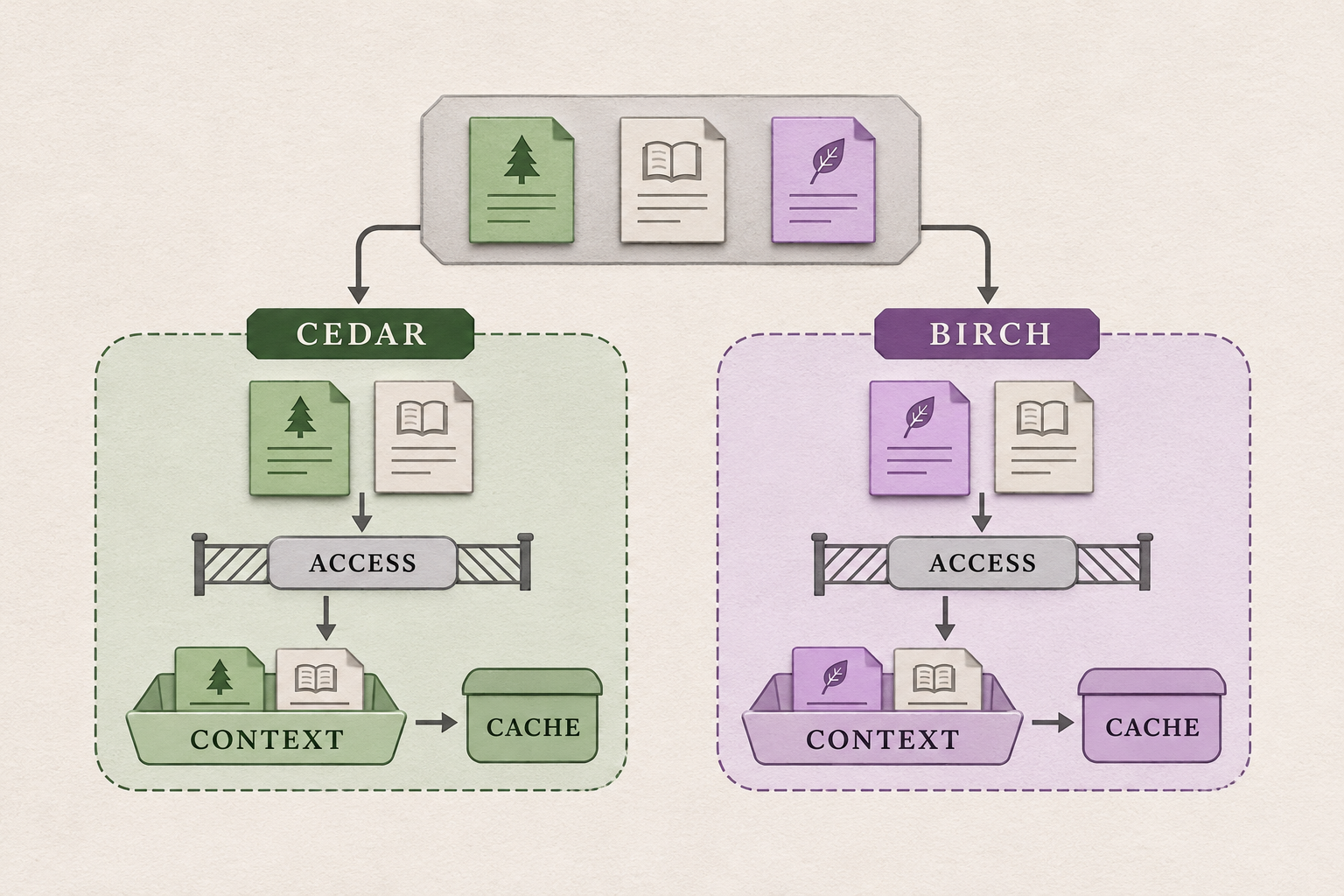
Enforce document permissions before restricted content enters the RAG context, then preserve that boundary through reranking, caching, answer storage, and citation access. The requesting identity must determine which evidence is eligible. Asking the model to ignore private passages after retrieving them is too late: the content has already crossed into the model's input.
Authorization is part of the retrieval contract. A highly relevant passage from a document the user cannot access is a security failure, not a successful search result.
Carry identity into the query through a trusted path
Derive the requesting identity and tenant from authenticated application state. Resolve permitted groups or resources through the authorization system. Do not accept a client-supplied group list as proof that the caller belongs to those groups.
For a synthetic two-team corpus, imagine three documents: an organization-wide handbook, Team Cedar's incident notes, and Team Birch's roadmap. A Cedar user may retrieve the handbook and Cedar notes; a Birch user may retrieve the handbook and Birch roadmap. A caller with no established permission receives no private documents.
Authenticated request
    → authorization context
    → eligible document set
    → retrieval and reranking within that set
    → model context
    → authorized answer and citation delivery
This is an application design, not a trace from a deployed RAG service. OWASP's authorization guidance recommends deny-by-default behavior and validating permissions on every request. Apply those principles to document retrieval, not only to the final web page.
Choose a boundary the search service actually enforces
Some implementations support document-level access controls in the search layer. Others rely on an application gateway with credentials and query rules that clients cannot bypass. Evaluate the actual path and credential scope; the label “security filter” does not establish that it is mandatory.
Elastic's document and field security documentation describes role-based document restrictions for read operations. It also documents how permissions from multiple roles combine. In particular, a broader role can defeat an intended restriction; adding a restrictive role does not necessarily narrow an existing broad grant.
That is a product-specific example, not a claim that every vector store implements the same semantics. Confirm the supported query modes, role composition, operational limitations, and enforcement behavior for the deployed version.
A broad service credential combined with an optional query filter is especially important to inspect. If another application endpoint can issue an unrestricted query with the same credential, the proposed boundary may exist only in one handler.
Keep unauthorized passages away from downstream processors
Filter eligibility before passing candidate text to rerankers, summarizers, model calls, or external tools. Removing a restricted paragraph from the final answer cannot remove it from a processor that already received it.
Filtering a large unrestricted top-k result afterward can also leave too little useful evidence for the caller. Design retrieval within the permitted corpus, then evaluate relevance there. If the engine applies filters differently across keyword and vector paths, test both paths and their combination rather than assuming one setting covers every query.
Titles, snippets, counts, and errors can disclose information even when the full body is hidden. Define what metadata the caller may learn. Access to a citation's title and source URL needs the same deliberate treatment as access to its passage.
Partition reuse by the permissions that matter
A query-only cache key is unsafe when two users can ask the same question but see different documents. Answer reuse needs an authorization scope and a policy for changes to that scope, as well as the source and index versions relevant to the result.
For the two-team example, a Cedar answer about a launch must not be reused for Birch simply because their question text matches. Even within one group, a source can become more restricted after the answer was cached. Decide whether to invalidate affected entries, reauthorize before reuse, or avoid caching sensitive answers when the dependency tracking is insufficient.
Session memory is another reuse path. A user who loses permission may still have old passages in stored conversation state. A fresh retrieval filter does not remove those earlier messages automatically. Define how the application handles permission changes, retained transcripts, exports, and later turns. Do not promise retroactive erasure of content a user already saw.
Test permission changes without changing the document text
Use controlled identities and synthetic documents to inspect these cases:
| Case | Expected observation |
|---|---|
| Cedar user asks for Cedar notes | Permitted passages may reach generation |
| Birch user asks the same question | Cedar passages and private metadata do not cross the boundary |
| Group membership is revoked | Later retrieval and reusable results follow the updated policy |
| An old index job completes after revocation | It cannot reactivate outdated permission metadata |
| A copied citation URL is opened by another user | The source endpoint applies its own access check |
| Authorization data cannot be resolved | The request safely stops instead of broadening access |
The table is a proposed acceptance plan; no Elastic cluster, model call, or authorization service was executed here. Verify the inputs at each processor, not only the final wording. Use authorized diagnostic records with redaction so the test does not create another unrestricted copy of the corpus.
Keeping a RAG index fresh covers version and deletion propagation. Permission updates require the same attention even when no words change. Object-level authorization supplies the related application boundary: possession of an identifier or a relevant result is never a substitute for permission to access it.