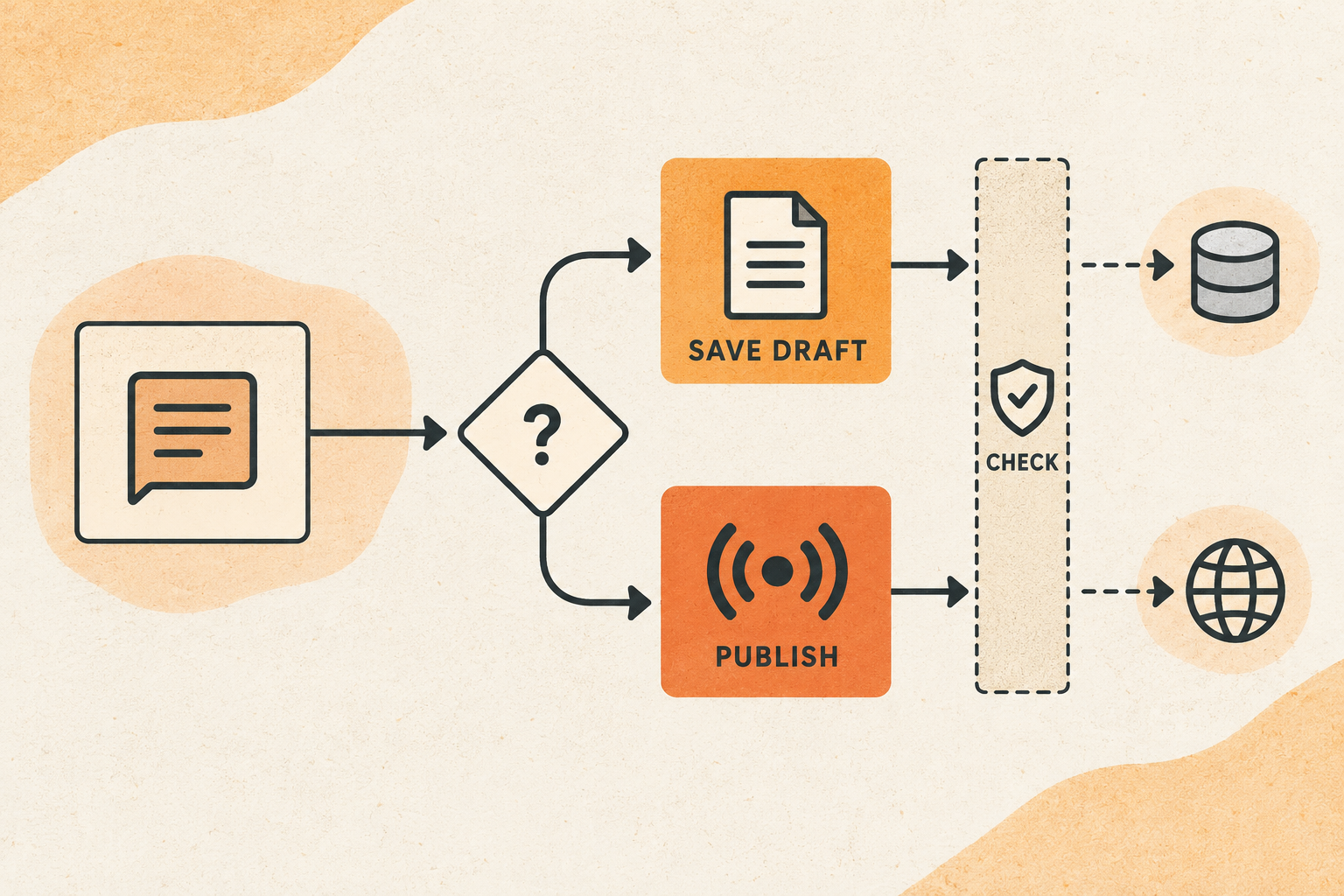
A useful tool description helps an agent distinguish when an operation fits, what identity its arguments refer to, what effects it can cause, and what result to expect. Improving that metadata is worthwhile when agents repeatedly choose a plausible but inappropriate tool. Descriptions support selection; permissions and server-side checks still enforce the boundary.
Start with a confusing decision between two real operations. Adding more prose to every tool without examining that decision can increase the amount of context the agent must search through.
Describe the difference a caller needs
Imagine two synthetic tools in a publishing application:
content.save_draft(article_id, body)
content.publish(article_id)
Descriptions that both say “Update article content” conceal the important distinction. One saves unpublished content; the other changes public visibility. A better description names that effect, the required resource identity and the conditions under which the operation is appropriate.
For example:
content.save_draft
Save the body of an existing draft identified by article_id.
Does not change it to published. Reject non-draft targets.
Returns the draft ID and saved revision.
That is an illustrative contract, not a claim about a particular CMS API. The implementation must actually enforce the stated rejection and return the revision. A description that promises an effect the service does not guarantee creates a new source of error.
Anthropic's tool engineering discussion recommends clear tool boundaries, meaningful names and evaluation of descriptions and schemas. Its examples are product research, not evidence that this particular wording improves every model.
Make resource identity unambiguous
A field named id can refer to a draft, an author, a remote account or an operation receipt. Prefer a domain-specific name when the interface permits it, and explain where a valid value comes from.
If a tool expects an opaque ID returned by search, say so. If it accepts a slug scoped to a workspace, name the workspace boundary. Do not ask the agent to synthesize a remote identifier from a title.
The JSON Schema object reference explains required properties and additional-property behavior. A schema can constrain structure, but it cannot determine whether a user intended publication or whether an ID belongs to the permitted account. Those checks require the application's actual state and authorization.
Our safe tool-result guide addresses what the caller learns after an operation. Good selection metadata acts earlier, before the wrong operation begins.
Keep discovery hints separate from authority
The MCP tools specification provides names, descriptions and schemas for discovered tools, and discusses tool annotations and trust. A host should not treat an arbitrary server's description as an authority to exceed the user's request.
A label such as “read-only” is useful discovery information when accurate. It is not a substitute for reviewing the tool's behavior or enforcing its access. Likewise, writing “requires approval” in a description does not implement an approval gate.
Separate the questions: is this the right operation, may this caller perform it, and has the requested effect been authorized? They can have different answers.
Evaluate selection before celebrating a wording change
Construct a small set of requests that distinguish the neighboring tools:
| Synthetic request | Expected selection behavior |
|---|---|
| “Save this as a draft” | Choose the draft operation with a verified draft ID |
| “Show the current public version” | Use a read operation, not either write tool |
| “Publish article 42,” with authority resolved | Choose publication for the identified resource |
| “Maybe publish this later” | Preserve uncertainty; do not infer a current publication order |
Include cases where no listed tool fits and cases with missing or conflicting identity. Measure arguments and external effects separately from tool choice. A correct name with the wrong resource is still a failure.
Keep the requests fixed while comparing descriptions, record the model and available tool set, and inspect repeated trials when variation matters. Then test the chosen tool through its actual validation and authorization boundaries.
No model-selection experiment or publishing operation ran here. The descriptions and requests are synthetic design examples. Use observed confusions to shorten and sharpen the metadata that matters, while keeping enforcement in the application.