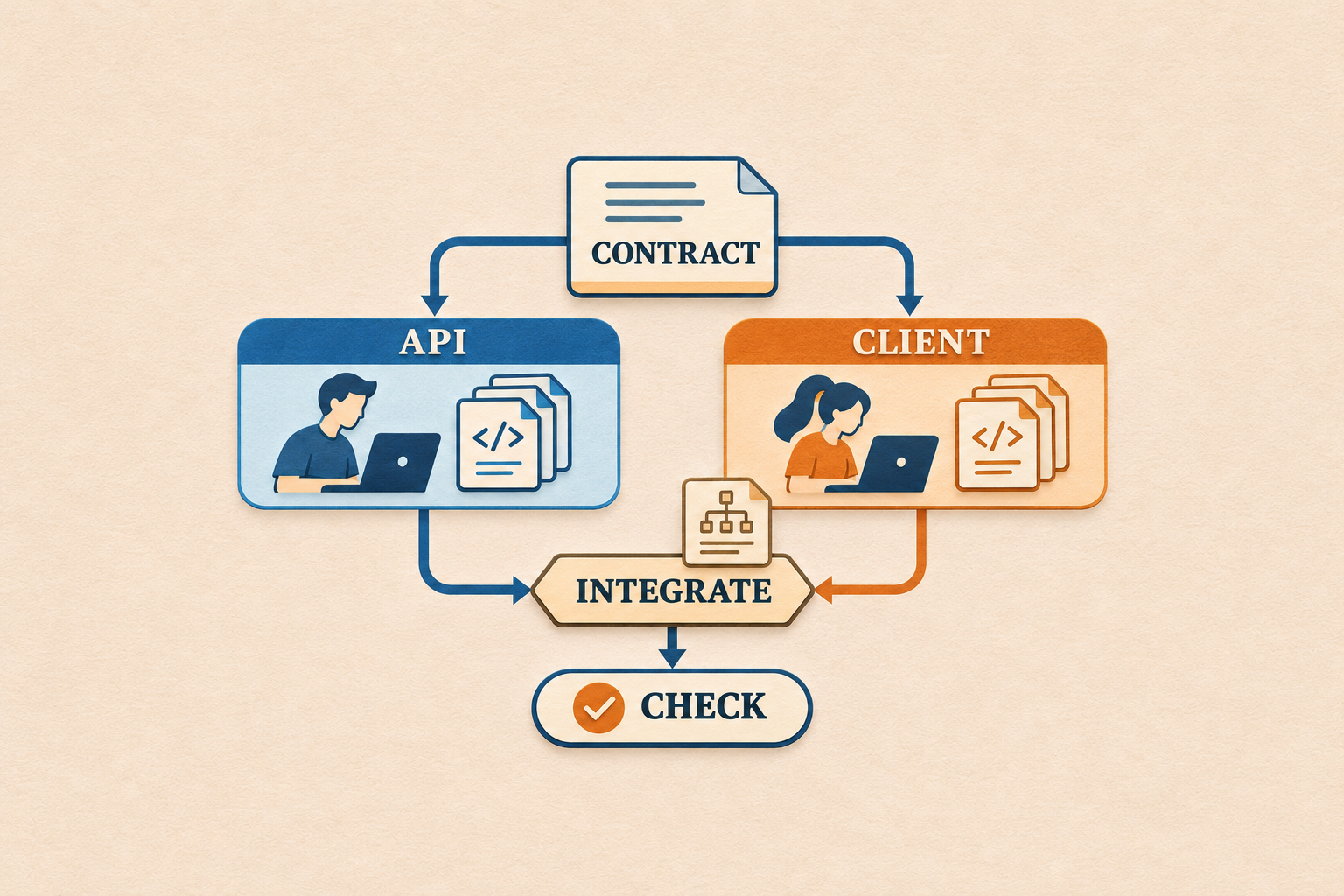
Parallel coding agents need a division of responsibility before they need more workers. Assign each editable surface an owner, settle shared interfaces first, and give one person or coordinator responsibility for the integrated result. Separate checkouts reduce direct file interference, but they cannot make incompatible assumptions agree.
Use parallel implementation when independent outputs remain useful without constant renegotiation. When every worker needs the next decision from the others, a sequential handoff can be simpler and easier to verify.
Start with one integration contract
Imagine adding export-job status to an API and a web client. Two workers can appear independent: one changes the server, the other changes the screen. Yet both need the same status values, response shape, and meaning of completion.
Settle those shared inputs first. In this constructed example, the accepted values are queued, running, completed, and failed. A completed job includes a result reference; a failed job exposes a safe public error code. Neither worker may invent another value to simplify its own implementation.
Anthropic's workflow patterns distinguish splitting a task into parallel sections from making repeated independent attempts. For editing, use sections with explicit dependencies. Two agents independently redesigning the same contract are performing competing proposals, not implementing an agreed interface.
Assign files and decisions, including shared artifacts
A small ownership record can make the division concrete:
| Surface | Owner | Required input | Expected output |
|---|---|---|---|
| Status contract and compatibility policy | Integrator | Existing consumers and rollout constraint | Frozen contract revision |
| API handler and server tests | Server worker | Contract revision | Bounded server patch and test evidence |
| Client rendering and client tests | Client worker | Same contract revision | Bounded client patch and test evidence |
| Shared schema and generated client | Integrator | Both patch proposals | One reconciled update |
| Integrated acceptance check | Integrator | Combined candidate | Evidence against the shared contract |
The table is a proposed coordination protocol, not a report of an executed agent team. File ownership is an agreement about editing, not an operating-system access control. If the environment needs enforced restrictions, configure and test those separately.
Identify lockfiles, generated sources, snapshots, migration ordering, and shared fixtures before assigning work. Avoid making two workers independently regenerate a shared artifact and asking a reviewer to select a result after the fact.
Brief each worker with a boundary it can recognize
A useful assignment names the starting revision, owned files, frozen contract, acceptance criteria, dependencies, and stop conditions. It also says what to return: resulting revision or patch, changed files, commands actually run, results, and unresolved findings.
For the server worker, a stop condition might be: “If implementing completed requires a field missing from the frozen schema, report the mismatch before changing the shared schema.” That preserves a decision boundary. Otherwise, a local improvement can silently redefine what the client worker is building against.
Do not request an enormous running transcript as the integration artifact. Preserve the evidence needed to inspect the patch and reproduce its checks. A concise summary can point to that evidence without replacing it.
Isolate mutable runtime state too
Git worktrees separate working directories and indexes. A shared database, test port, build-output directory, or external account can still connect their effects. Give concurrent checks suitable fixtures and outputs, and keep consequential external writes within their own authorization.
An agent restricted to one file can still create incompatible behavior through that file. Conversely, two read-only reviewers can inspect the same files without competing edits. Choose the boundary according to the operation, not merely the path count.
Expect clean merges with broken behavior
Suppose the server emits queued while the client expects pending. Each worker writes unit tests using its own chosen value. Both suites pass, and their patches touch different files. Git may combine the text without a conflict while the screen never shows the intended waiting state.
Git's merge documentation describes combining histories and resolving content conflicts. A successful merge is not evidence that the resulting application satisfies the shared interface. An integration check must connect the server's actual response to the client's accepted behavior.
For this scenario, freeze the contract, integrate the proposed changes, and verify a queued job, a running job, a completed result, a safe failure, and an unfamiliar status. Decide compatibility behavior explicitly rather than deriving it from whichever worker finished first. These are illustrative cases; no Git merge or application test was run for this article.
Rebrief when a dependency changes
If the contract changes, identify affected workers and the revision they used. Stop work that would otherwise build on an obsolete assumption, update the shared decision, and let affected workers resume from known inputs. Do not treat a message sent as proof that every worker has incorporated it.
Keep one integration owner accountable for the combined diff, shared artifacts, and final acceptance. Worker-level passes remain useful evidence about their patches. They do not automatically cover the combined revision.
The broader decision about single-agent and multi-agent workflows comes first. This protocol addresses the narrower case where parallel editing has already been justified. It makes no claim of measured speedup or token savings. Keep parallelism when it produces independently reviewable work and a manageable integration step; reduce it when coordination becomes the main task.