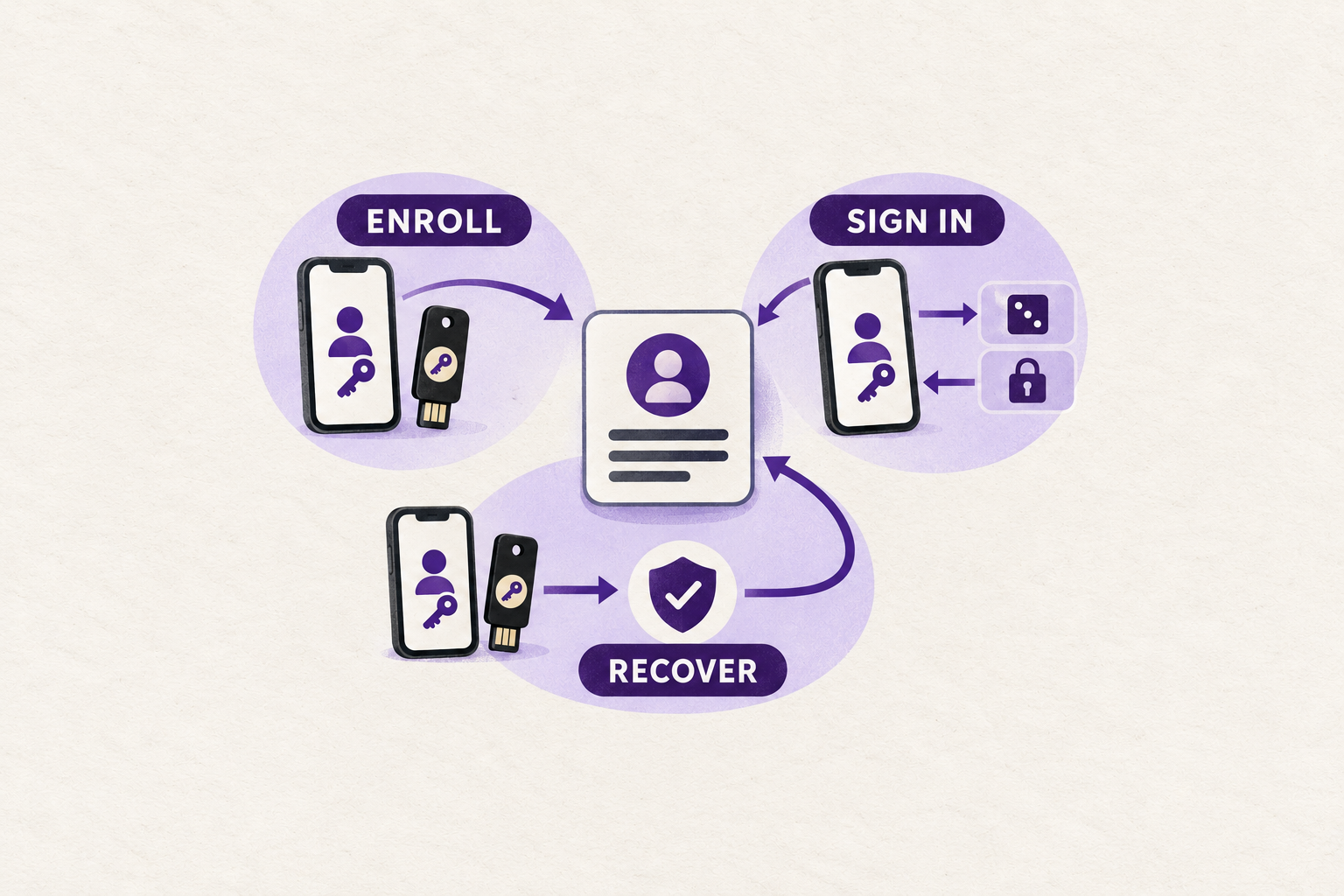
Passkeys change how an application authenticates a user, but the application still needs to design enrollment, additional authenticators, credential removal, session handling and account recovery. A strong login ceremony can be undermined by a recovery path that gives an attacker an easier way to take over the same account.
Start by mapping the account lifecycle, not only the login button. Distinguish what the authenticator or passkey provider manages from what the relying application must verify and authorize.
Separate the credential from the account
The FIDO passkey overview describes public-key authentication using passkeys, including credentials that may be synchronized through a provider or bound to an authenticator. Availability after losing a device depends on the actual credential and provider arrangement; “passkey” alone does not specify a universal recovery experience.
The application associates registered credentials with an account. It does not need to receive the credential's private key to verify an authentication response. That relationship is specified through WebAuthn, whose registration and authentication procedures include server-side verification requirements.
Credential IDs, user handles and human-facing account names serve different purposes. Decide how an account can have multiple credentials and how a person can identify or remove one without accidentally removing their only working sign-in path.
Treat enrollment as an account-changing action
Consider a fictional customer account that already has one passkey. A request to add another credential changes who may later authenticate as that account. An authenticated browser session alone may not be sufficient assurance for every application or risk level.
OWASP's authentication guidance discusses reauthentication after risk events and protecting sensitive account actions. Use the application's threat model to decide what recent verification is required before adding or removing an authenticator.
An enrollment flow should establish which account is being changed, issue the appropriate fresh challenge, verify the returned registration data through a maintained implementation, and save the credential association only after successful validation. Avoid designing a new cryptographic protocol around a browser response.
Keep a visible credential-management view. A user should be able to distinguish a security key from another registered option using useful labels and available metadata, without exposing secret material.
Verify the response in its intended context
The relying application must validate the ceremony against its challenge, expected origin and relying-party identity, along with the other applicable WebAuthn checks. Reading a credential ID from the response is not a complete authentication decision.
User presence and user verification are also different signals. Choose the required verification policy deliberately and validate the result rather than assuming a device prompt always represents the same assurance.
A successful ceremony establishes an authentication result. The application then decides which session to create or refresh and what that session may do. Our OAuth scopes and audiences guide addresses related authorization boundaries; passkey authentication does not itself grant access to every object in the application.
Plan loss and recovery before rollout
For the fictional account, ask what happens if the sole authenticator becomes unavailable. Does the user have another registered credential? Does a synced credential remain accessible through the provider? What recovery path does the application support if neither is available?
FIDO's deployment guidance discusses emerging practices for synced passkeys and points to relying-party recovery considerations. Provider recovery and application account recovery should be examined together, without treating them as identical systems.
Write down the fallback's assurance and limits. A password or email recovery route may remain for migration or accessibility, but its existence affects the account's overall takeover resistance. Do not advertise an assurance level that the easiest effective recovery route cannot support.
Test the lifecycle, not only a successful login
A practical acceptance matrix includes first enrollment, adding a second credential, removing one, loss of the preferred authenticator, failed verification, and attempts to reuse or mismatch a challenge. Test supported browsers and authenticator arrangements relevant to the audience.
Include an attacker holding a stolen session in the model for credential management. Include a legitimate user who has lost access when reviewing recovery. Both cases matter to the same lifecycle.
This article is a design review using a fictional account, not a completed WebAuthn integration or a security certification. Verify current library support, protocol requirements and the chosen recovery process before implementing the flow.